Scroll
Who They Were
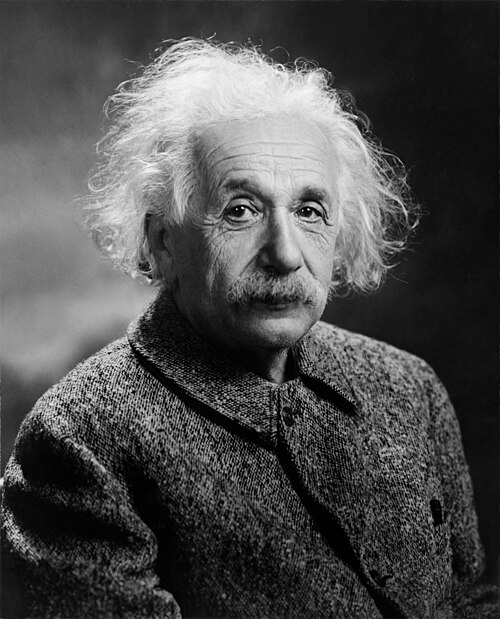
Picture a clerk in a Bern patent office in 1905, hair already wild, mind already wilder. Albert Einstein is twenty-six years old. In a single year he will publish four papers that crack open the universe — on light, on atoms, on energy, on the elasticity of time itself.
He is not a prodigy by the standards of his teachers. He is dreamy, stubborn, rebellious about authority. He asks questions other physicists consider settled. He chases a thought experiment — what would it look like to ride a beam of light? — for ten years until it births a theory.
Later he becomes the most famous scientist alive, an unwilling pop icon with a violin and a mustache. He warns of the atomic bomb he helped make possible. He defends civil rights and refuses the presidency of Israel. He spends his last decades searching for one equation to unify it all — and dies still searching, exactly as he lived.
What They Stood For
He believed wonder was the engine of every breakthrough. The universe wasn't a puzzle to win — it was a mystery to keep loving, question by question.
He saw war as humanity's deepest failure of imagination and spoke against militarism even when it cost him friends and homelands.
He distrusted certainty in any form — religious, political, scientific. To him, the mark of a real mind was the willingness to be wrong.
Ask the Legend
Powered by AI trained on their public legacy — interviews, speeches, and documented beliefs.
💌 Want Albert Einstein to speak directly to you?
Get a Personal Message — $9.99Explore Albert Einstein's Legacy
As an Amazon Associate, AskTheLegends.com earns from qualifying purchases.
Their Legacy
A quiet, late-talking child who would later joke that's why he kept asking adult questions about space and time.
Publishes four world-changing papers, including special relativity and E=mc².
Rewrites gravity itself — bending space, bending time, predicting black holes.
Wins the Nobel for explaining the photoelectric effect, the seed of quantum theory.
Leaves Nazi Germany for Princeton, where he spends the rest of his life.
Did You Know?
01
Einstein took up the violin seriously in his teens and returned to it throughout his life, especially during moments of intellectual struggle. He believed the music helped him unlock solutions to complex physics problems.
02
Einstein spoke his final words in German to a nurse who did not understand the language, meaning his last utterance remains unknown to history—a fitting mystery for a man who spent his life unraveling them.
03
In the 1930s, concerned about toxic leaks in home refrigerators, Einstein co-designed an absorption refrigerator with Leó Szilárd. Though never commercially produced, the patent demonstrates his practical curiosity beyond theoretical physics.
04
Einstein believed that imagination—the ability to envision what does not yet exist—was more important than accumulated knowledge. This conviction shaped not only his science but his philosophy of learning and discovery.
In Their Own Words
Imagination is more important than knowledge. Knowledge is limited to all we now know and understand, while imagination embraces the entire world and all there ever will be to discover.
Life is like riding a bicycle. To keep your balance, you must keep moving.
The important thing is not to stop questioning. Curiosity has its own reason for existing.
Quotes sourced from public record.
The Question of Our Time
What would Albert Einstein say about artificial intelligence?
I believe intelligence itself is simply a tool—a very powerful one, but a tool nonetheless. What matters most is the wisdom and imagination that guides its use, not the machinery that performs it. A machine can solve equations faster than any human mind, but it cannot ask why the equation matters, or dream of what it might become. That creative curiosity, that hunger to understand the universe's deepest secrets—that remains uniquely human. We must never confuse the capacity to calculate with the capacity to imagine.
— In the voice of Albert Einstein, generated by AI
Go Deeper
Books
Walter Isaacson's definitive biography and Einstein's own essays on life, peace, and the cosmos.
Read His Mind on AmazonMusic
Mozart and Bach were his daily devotion. The violin sonatas he played alone in his study, every night.
Hear What He Heard on AmazonDocumentary
Genius, Einstein's universe, and the films that bring his strange and beautiful physics to life.
Watch His Universe on AmazonYou Might Also Ask…
Genius. Curious. Human.. They are remembered as one of the most influential figures in Art & Science.
Albert Einstein is known for their groundbreaking impact on Art & Science. Their legacy continues to inspire millions worldwide.
Yes. AskTheLegends.com uses AI to simulate conversations with Albert Einstein, letting you ask questions and get responses inspired by their real words and philosophy.
Browse Albert Einstein books, albums, and documentaries on Amazon using the legacy links at the bottom of this page.
Daily Wisdom from the Legends
Get daily wisdom from the legends — free. Straight to your inbox.