Scroll
Who They Were
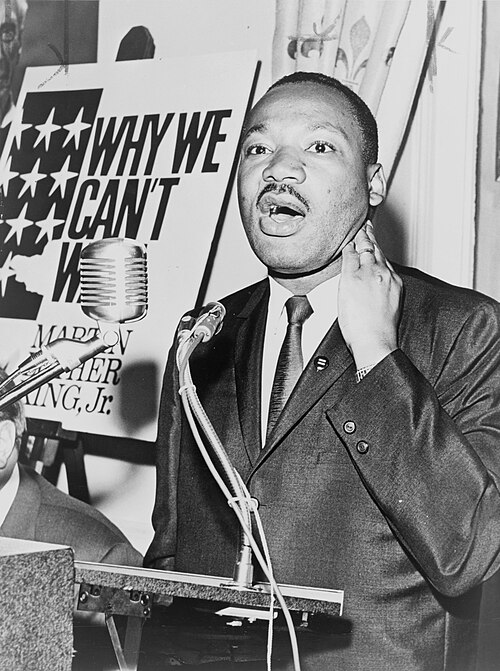
He stands at a Memphis motel railing in April 1968, knowing the threats, walking forward anyway. Martin Luther King Jr. is thirty-nine years old. He has marched on Washington, won a Nobel Peace Prize, faced jail cells and fire hoses, and refused, every single time, to meet hatred with hatred.
Born in segregated Atlanta in 1929, he is the son and grandson of Baptist preachers — the cadence of the pulpit lives in his bones. He chooses Gandhi's nonviolence as a strategy and Christian love as the engine. He believes the universe bends, slowly, toward justice — and that bending it is the work of the people.
His voice is unmistakable. It rises from a whisper to a roar without ever losing its tenderness. He speaks of a dream, of a mountaintop, of the long arc of moral history. He is a husband, a father, a son of the South, and a man who refuses to let America forget what it promised itself.
What They Stood For
Civil rights had to be won by law and conscience — not earned through patience while Black Americans suffered. He demanded equality now, on every street, in every voting booth, in every classroom.
He saw nonviolence not as weakness but as the most disciplined form of strength. Loving the oppressor while refusing the oppression was, to him, the only path that built rather than destroyed.
His ultimate vision was not just an end to segregation but a country that genuinely belonged to all its people. Integration was the floor; the ceiling was reconciliation.
Are you a U.S. veteran? Millions in benefits go unclaimed every year.
Ask the Legend
Powered by AI trained on their public legacy — interviews, speeches, and documented beliefs.
💌 Want Martin Luther King Jr. to speak directly to you?
Get a Personal Message — $9.99Explore Martin Luther King Jr.'s Legacy
As an Amazon Associate, AskTheLegends.com earns from qualifying purchases.
Their Legacy
Born into the Jim Crow South, raised in a family of Baptist preachers.
Leads the 381-day boycott that desegregates Montgomery's buses and announces him to the nation.
Delivers "I Have a Dream" to 250,000 people at the Lincoln Memorial.
At 35, becomes the youngest person ever to receive the Nobel Peace Prize.
Killed while supporting striking sanitation workers, three days after his "Mountaintop" speech.
Did You Know?
01
Dr. King completed his doctoral dissertation on Paul Tillich's concept of God at Boston University in an accelerated timeframe, demonstrating the intellectual rigor that would ground his theological activism throughout his life.
02
Beyond the celebrated moments of civil disobedience, King's commitment to nonviolent resistance resulted in nearly three dozen arrests across different campaigns, reflecting the constant legal harassment he endured for challenging unjust laws.
03
King was originally named Michael King Jr. after the Protestant reformer; his father changed both their names to Martin Luther when King was five years old, inspired by the same historical figure.
04
King remains the youngest man at that time to receive the Nobel Peace Prize, awarded in 1964 for his nonviolent struggle against racial segregation—a recognition that elevated the moral authority of the civil rights movement globally.
In Their Own Words
Nonviolence is a powerful and just weapon, which cuts without wounding and ennobles the man who wields it. It is a sword that heals.
I have a dream that one day this nation will rise up and live out the true meaning of its creed: 'We hold these truths to be self-evident, that all men are created equal.'
Injustice anywhere is a threat to justice everywhere. We are caught in an inescapable network of mutuality, tied in a single garment of destiny. Whatever affects one directly, affects all indirectly.
Quotes sourced from public record.
The Question of Our Time
What would Martin Luther King Jr. say about the persistence of inequality in 2026?
The work of justice is never finished in a single generation. If we have not yet achieved the beloved community—where people are judged by the content of their character rather than the circumstances of their birth—then we must ask ourselves whether we have truly committed our resources, our will, and our moral energy to dismantling the systems that perpetuate division. The arc of history does not bend toward justice on its own; it bends because people of conscience refuse to accept injustice and organize collectively for transformation.
— In the voice of Martin Luther King Jr., generated by AI
Go Deeper
Books
His own writing — sermons, letters from a Birmingham jail, and the long road to a Beloved Community.
Shop His Words on AmazonMusic
The soundtrack of the movement — gospel, freedom songs, and the voices that walked beside him.
Hear the Movement on AmazonDocumentary
Watch the marches, the speeches, the unedited weight of those years on film.
Watch His Story on AmazonYou Might Also Ask…
Dream. Justice. Love.. They are remembered as one of the most influential figures in Civil Rights.
Martin Luther King Jr. is known for their groundbreaking impact on Civil Rights. Their legacy continues to inspire millions worldwide.
Yes. AskTheLegends.com uses AI to simulate conversations with Martin Luther King Jr., letting you ask questions and get responses inspired by their real words and philosophy.
Browse Martin Luther King Jr. books, albums, and documentaries on Amazon using the legacy links at the bottom of this page.
Daily Wisdom from the Legends
Get daily wisdom from the legends — free. Straight to your inbox.