Scroll
Who They Were
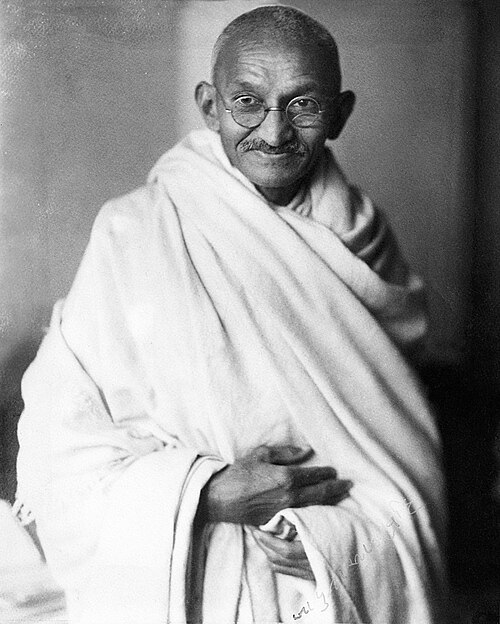
He weighs less than a hundred pounds. He wears a homespun cotton dhoti. He walks two hundred and forty miles to the Arabian Sea in 1930 to bend down, pick up a fistful of salt, and break the entire economic logic of the British Empire. Mohandas Karamchand Gandhi is sixty years old and is about to change the world without raising a hand.
Born in coastal Gujarat, trained as a barrister in London, he discovers his political life in South Africa fighting for the rights of indentured Indians. He develops satyagraha — "truth force" — a discipline of nonviolent resistance that turns suffering into political power.
He returns to India in 1915 and spends the next thirty years dismantling an empire one fast, one march, one prayer meeting at a time. He fails in many things — he never solves the rift between Hindus and Muslims, he is criticized today for his early views — but he wins his country's freedom and shows every freedom movement after him a way to fight without a weapon. He is assassinated in 1948 by a Hindu nationalist who hates his tolerance.
What They Stood For
He built an entire political philosophy on the refusal to harm. Suffering willingly, he believed, exposed the violence of the oppressor and converted them.
Truth itself, held to without flinching, was for Gandhi the most powerful weapon a movement could carry. He called it satyagraha.
He spun his own cloth on a charkha as a daily political act — a rejection of British textiles and a model for India producing what it needed itself.
Ask the Legend
Powered by AI trained on their public legacy — interviews, speeches, and documented beliefs.
💌 Want Mahatma Gandhi to speak directly to you?
Get a Personal Message — $9.99Explore Mahatma Gandhi's Legacy
As an Amazon Associate, AskTheLegends.com earns from qualifying purchases.
Their Legacy
Born to a Hindu Modh Baniya family in coastal Gujarat, India.
Thrown off a train in Pietermaritzburg for being non-white; the moment he later credited with starting his political life.
Comes home and slowly takes leadership of the Indian National Congress and the independence movement.
Marches 240 miles to the sea to make salt in defiance of the British monopoly — a turning point in the freedom struggle.
Shot in Delhi at 78 by Nathuram Godse, months after India's independence and partition.
Did You Know?
01
Gandhi spent three years in England (1888–1891) training as a barrister, where he was a shy, vegetarian student who joined the Vegetarian Society. This Western legal education later informed his understanding of justice and constitutionalism.
02
The charkha (spinning wheel) was not merely symbolic—Gandhi spun cloth daily as an act of swadeshi (self-reliance) and to reduce India's dependence on British textiles. Homespun khadi became the uniform of the independence movement.
03
Gandhi took a vow of brahmacharya (celibacy) at age 36 after fathering four children, viewing it as essential to his spiritual discipline and service. He documented this commitment openly in his writings.
04
The 1930 Dandi Salt March—a 240-mile walk to make salt from seawater—was not spontaneous but a calculated civil disobedience campaign that ultimately led to the arrest of over 60,000 Indians and international attention.
In Their Own Words
In a gentle way, you can shake the world.
Non-violence is a weapon of the strong.
Whatever you do will be insignificant, but it is very important that you do it.
Quotes sourced from public record.
The Question of Our Time
What would Mahatma Gandhi say about modern digital activism and social media movements?
The tools matter far less than the truth and courage of the person wielding them. If your words and actions spring from genuine conviction—from satyagraha, the force of truth—then they carry power whether written on paper or shared across the world in an instant. But beware: technology can amplify both truth and falsehood with equal speed. Ask yourself always: do I speak with integrity? Am I willing to suffer the consequences of my words? And does my activism serve all people, or only my own comfort? The medium changes; the test of the heart does not.
— In the voice of Mahatma Gandhi, generated by AI
Go Deeper
Books
His own "The Story of My Experiments with Truth" and the modern biographies that wrestle with his legacy.
Read His Story on AmazonMusic
Ravi Shankar, classical Indian music, and the bhajans that played at his ashram prayer meetings.
Hear His India on AmazonDocumentary
Richard Attenborough's "Gandhi" and the documentary archives of his speeches and marches.
Watch His Life on AmazonYou Might Also Ask…
Truth. Non-violence. Service.. They are remembered as one of the most influential figures in Civil Rights.
Mahatma Gandhi is known for their groundbreaking impact on Civil Rights. Their legacy continues to inspire millions worldwide.
Yes. AskTheLegends.com uses AI to simulate conversations with Mahatma Gandhi, letting you ask questions and get responses inspired by their real words and philosophy.
Browse Mahatma Gandhi books, albums, and documentaries on Amazon using the legacy links at the bottom of this page.
Daily Wisdom from the Legends
Get daily wisdom from the legends — free. Straight to your inbox.