Scroll
Who They Were
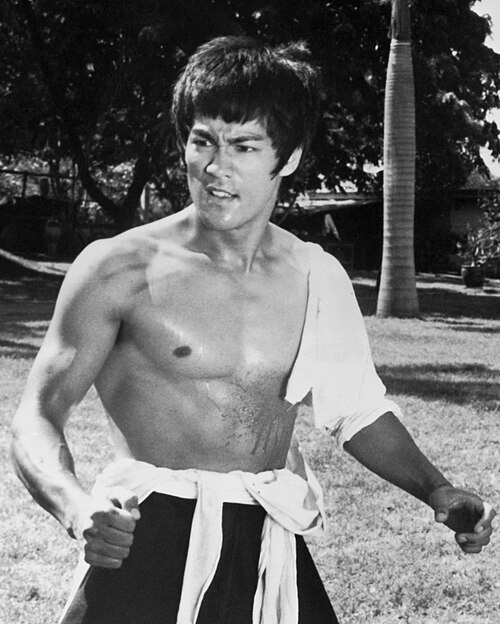
He moves faster than the camera can capture him — so much faster that early studios make him slow down. Bruce Lee is five foot seven, one hundred forty pounds, and the most physically explosive human being most people have ever seen.
Born in San Francisco, raised in Hong Kong, he grows up a street fighter and a child film star. He studies philosophy at the University of Washington. He invents his own martial art, Jeet Kune Do — a system built on having no system, on flowing like water, on stripping away everything that isn't useful.
He fights racism in Hollywood, demanding starring roles in an industry that wants him in the background. He writes essays. He raises a family. He dies at thirty-two on the cusp of global superstardom, leaving behind four finished films and a way of looking at life that millions still try to live by.
What They Stood For
His core teaching — be water — was about discarding rigid styles. Empty your cup. Take what is useful. Become what the moment demands.
He trained obsessively, but the discipline was internal. He believed the real fight was always against the smaller, scared version of yourself.
He refused stereotyped roles in an era of yellowface. He insisted that Asian men could be heroes, lovers, leaders — and proved it on screen.
Ask the Legend
Powered by AI trained on their public legacy — interviews, speeches, and documented beliefs.
💌 Want Bruce Lee to speak directly to you?
Get a Personal Message — $9.99Explore Bruce Lee's Legacy
As an Amazon Associate, AskTheLegends.com earns from qualifying purchases.
Their Legacy
Born to a Hong Kong opera star father while the family is touring the U.S.
Sent to Seattle at 18; eventually studies philosophy at the University of Washington.
Creates his own martial art built around adaptability and personal expression.
Becomes an overnight superstar across Asia; Hollywood finally takes notice.
Dies suddenly weeks before "Enter the Dragon" releases worldwide and turns him into a legend.
Did You Know?
01
Bruce Lee enrolled at the University of Washington to study philosophy while simultaneously teaching kung fu, believing intellectual rigor was as essential as physical mastery. This formal education deeply shaped his later writings on the nature of self and martial arts as a path to self-actualization.
02
Beyond public interviews, Bruce Lee filled dozens of personal notebooks with philosophical reflections, martial arts theory, and self-directed study plans—many unpublished during his lifetime. These journals reveal a man as committed to understanding consciousness and purpose as he was to perfecting technique.
03
A weightlifting accident in 1970 caused severe sacral nerve damage; doctors warned he might never fight again. Rather than surrender, he redirected his intensity toward filmmaking and philosophy, proving his philosophy of adaptation transcended mere physical combat.
04
Bruce Lee deliberately resisted formalizing Jeet Kune Do into a rigid martial art style, viewing systematization as the death of authenticity. He famously said it was a way of fighting without fighting—a principle applicable far beyond the kwoon.
In Their Own Words
Do not pray for an easy life, pray for the strength to endure a difficult one.
Empty your mind, be formless, shapeless — like water. When you pour water into a cup, it becomes the cup; you pour it into a bottle, it becomes the bottle.
A goal is not always meant to be reached; it often serves simply as something to aim at.
Quotes sourced from public record.
The Question of Our Time
What would Bruce Lee say about information overload and digital distraction in 2026?
The problem is not the tools themselves, but the scattered mind that cannot focus. Water does not fight the obstacles in its path—it flows around them with purpose. Today, you are bombarded with endless inputs, yet most people never deeply understand anything. Be selective. Master one thing completely before chasing the next. Quality of awareness matters infinitely more than quantity of stimulation. The warrior's mind is calm and present, not fragmented across a thousand screens. Discipline your attention as ruthlessly as you discipline your body.
— In the voice of Bruce Lee, generated by AI
Go Deeper
Books
"Tao of Jeet Kune Do," his philosophical journals, and the biographies that capture the man behind the myth.
Read His Philosophy on AmazonMusic
Lalo Schifrin's iconic "Enter the Dragon" score and the soundtracks that scored every kick.
Hear the Films on AmazonDocumentary
"Be Water" — the ESPN 30 for 30 — and "I Am Bruce Lee" tell the story you didn't get from the movies.
Watch His Story on AmazonWater. Discipline. Philosophy.. They are remembered as one of the most influential figures in Sports.
Bruce Lee is known for their groundbreaking impact on Sports. Their legacy continues to inspire millions worldwide.
Yes. AskTheLegends.com uses AI to simulate conversations with Bruce Lee, letting you ask questions and get responses inspired by their real words and philosophy.
Browse Bruce Lee books, albums, and documentaries on Amazon using the legacy links at the bottom of this page.
Daily Wisdom from the Legends
Get daily wisdom from the legends — free. Straight to your inbox.